The list looks different in 2026, but not by accident. GitHub’s 2025 Octoverse says TypeScript became the most-used language on GitHub in August 2025, passing both Python and JavaScript after adding more than 1 million contributors, a 66% year-over-year jump; Python added 850,000, and JavaScript added 427,000. That is not a cosmetic shift. It shows where teams are building, and where the hiring market is starting to follow.
TypeScript took the lead
TypeScript is no longer the careful option sitting next to JavaScript. It is now the default in much of modern web development, helped by frameworks that scaffold new TypeScript projects from the start, with GitHub specifically naming Astro, Next.js, and Angular in its 2026 analysis of why the language surged. The number that matters most is not style preference but usage: GitHub says TypeScript is now the most-used language on the platform, with an estimated 2.6 million developers after that 2025 jump. The observation from the ground is simple enough: typed front-end and full-stack code no longer feel optional.
Python still owns half the room
Python did not lose relevance when TypeScript moved past it on GitHub. TIOBE places Python at #1 in April 2026, and Stack Overflow’s 2025 Developer Survey says Python adoption accelerated sharply, rising by 7 percentage points from 2024 to 2025 as it kept its hold on AI, data science, and back-end work. That combination matters because it means Python is doing two jobs at once: it remains the language of choice for machine learning pipelines and automation, while still readable enough for teams that need fast iteration rather than ceremony. Different board. Same control.
Java and C# never really left
The quieter story in 2026 is how little the enterprise tier has changed. RedMonk’s January 2026 rankings show Java at #3, while C# moved up to tie PHP at #4, which is a rare movement that high in a ranking built from GitHub and Stack Overflow data. That does not read like nostalgia. It reads like payroll systems, cloud services, regulated sectors, and long-lived internal platforms continuing to hire for languages that are less fashionable than reliable.
Rust and Go are still gaining ground
This is where the market gets more selective. JetBrains’ 2025 ecosystem reporting continues to show interest in Rust, Go, and Kotlin, while older languages such as PHP, Ruby, and Objective-C remain under pressure in trend discussions. Stack Overflow’s 2025 survey also says Rust is again the most admired programming language at 72%, which helps explain why teams working on performance-heavy services, infrastructure, and developer tools keep circling it; in digital products tied to analytics, live data, payments, and even betting, reliability and latency are not side issues. They shape the stack.
Demand is moving with the product
The useful mistake is to think that language demand is determined solely by rankings. GitHub’s February 2026 analysis argues that AI is changing not just how code is written but what gets built with it, and that logic holds up when looking at mobile-first products, typed web applications, and services where onboarding speed matters as much as raw performance. In that sort of release cycle, the MelBet apk makes sense as a small example of why teams still hire around Android delivery, app maintenance, payment flows, and real-time updates rather than around abstract language loyalty. The codebase has to survive traffic spikes, store rules, device fragmentation, and one more rushed patch before kickoff.
The real list is shorter than it looks
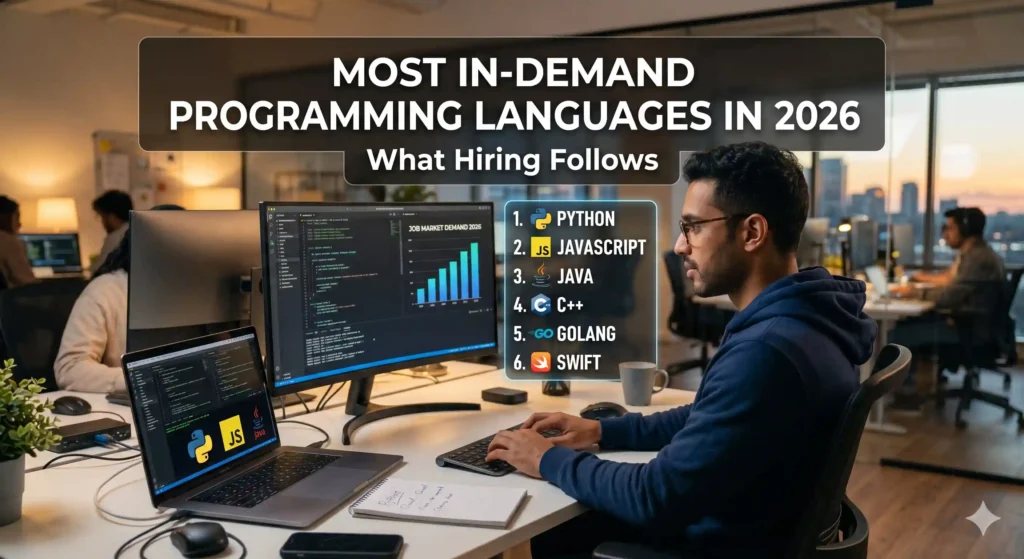
If the question is which languages are most in demand right now, the shortlist is tighter than the internet usually admits. TypeScript and Python sit in front. Java and C# remain durable hiring languages. Rust and Go keep gaining ground where systems, workloads, infrastructure, and performance matter, while Kotlin stays on the rise in JetBrains’ 2025 view, even if it does not dominate the broader rankings yet. The market has not become cleaner. It has become more specific.
What to learn if you are choosing now
The practical answer depends on the kind of work being targeted. TypeScript is the strongest choice for modern web stacks. Python remains the safest cross-market bet because AI, automation, and data work keep feeding demand. Java and C# still pay for stability, while Rust and Go are better picks for developers who want harder systems work rather than broadest access. The field is crowded. The hiring lanes are not.